
Manhattan resale condo PPSF just hit a record.
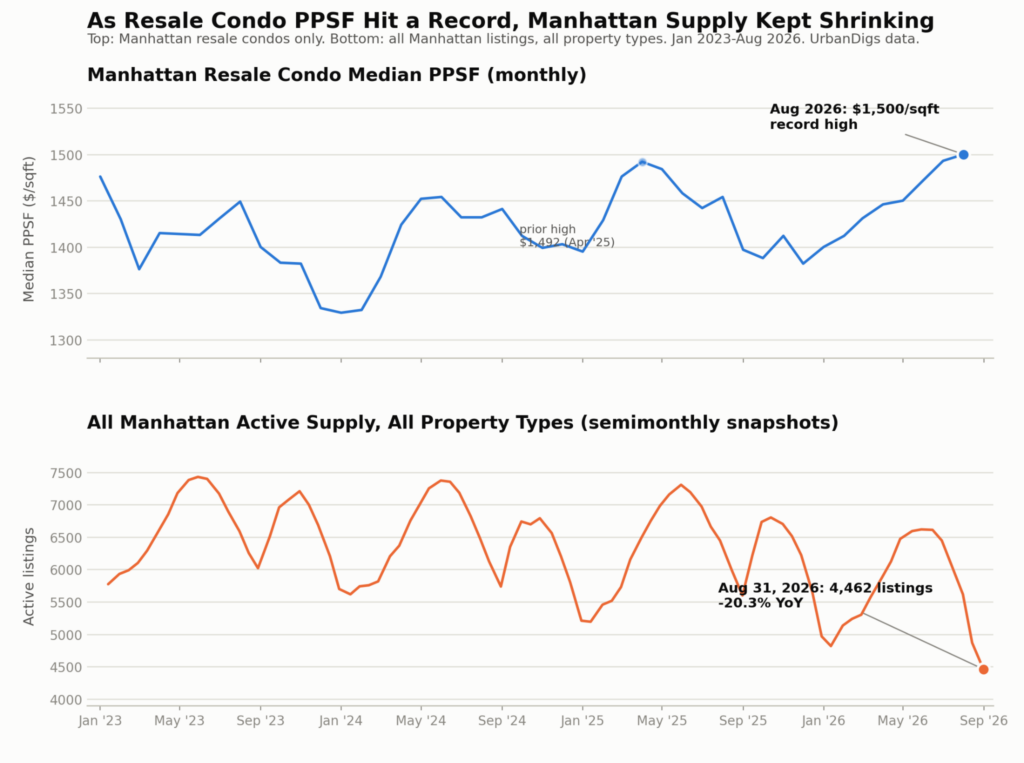
Median price per square foot for August is clocking in at $1,500, the highest monthly reading we’ve recorded going back to 2008. Q3 is tracking even higher so far at $1,508 per square foot, above the previous quarterly high of $1,472 set in Q2 2025.
Normally, a record like that would suggest a booming market.
Lots of buyers, lots of deals, bidding wars everywhere.
But that is not really what is happening.
Transaction volume remains relatively subdued. Mortgage rates are still elevated. The market just doesn’t feel anything like 2021.
Yet prices keep moving higher.
So the better question is: How are prices setting records in a market that still feels relatively quiet?
Fewer buyers, but even fewer sellers
The easiest way to think about the current market is that demand doesn’t have to be extraordinary if supply is tight enough.
Publicly visible Manhattan supply dropped 20% from a year ago and is at the lowest level we’ve seen in years.
Median listing discount is down to 3.7% quarter-to-date.
Market Pulse, our measure of buyer-versus-seller leverage based on contract activity relative to active supply, has remained solidly positive through 2026 after spending most of last spring and summer flat to negative.
There may not be a rush of buyers.
But the buyers who are active are competing for significantly fewer apartments.
Think of it as an extremely expensive game of musical chairs.
I wrote about this dynamic recently for Forbes because it runs against the normal higher-rate playbook.
Higher mortgage rates knocked down transaction volume as expected, but they didn’t push prices down nearly as much because they affected sellers too.
The lock-in effect kept sellers with earlier, lower mortgage rates and/or plenty of equity in place. Without a reason to move, they didn’t.
So fewer buyers were met with even fewer sellers.
And when supply falls faster than demand, low transaction volume doesn’t necessarily mean weak pricing.
That’s what’s happening in Manhattan right now.
But a record Manhattan number does not tell you what your apartment is worth
There is one important caveat.
Median Manhattan resale condo PPSF may be at a record, but residential pricing is intensely local.
Neighborhood matters.
Building matters.
Floor, view, layout, condition, renovation quality, outdoor space, timing, competing inventory, and the circumstances surrounding recent sales all matter.
The Manhattan PPSF record tells us something important about the market environment.
It does not tell us what any particular apartment should trade for.
And the neighborhood data makes that distinction even clearer.
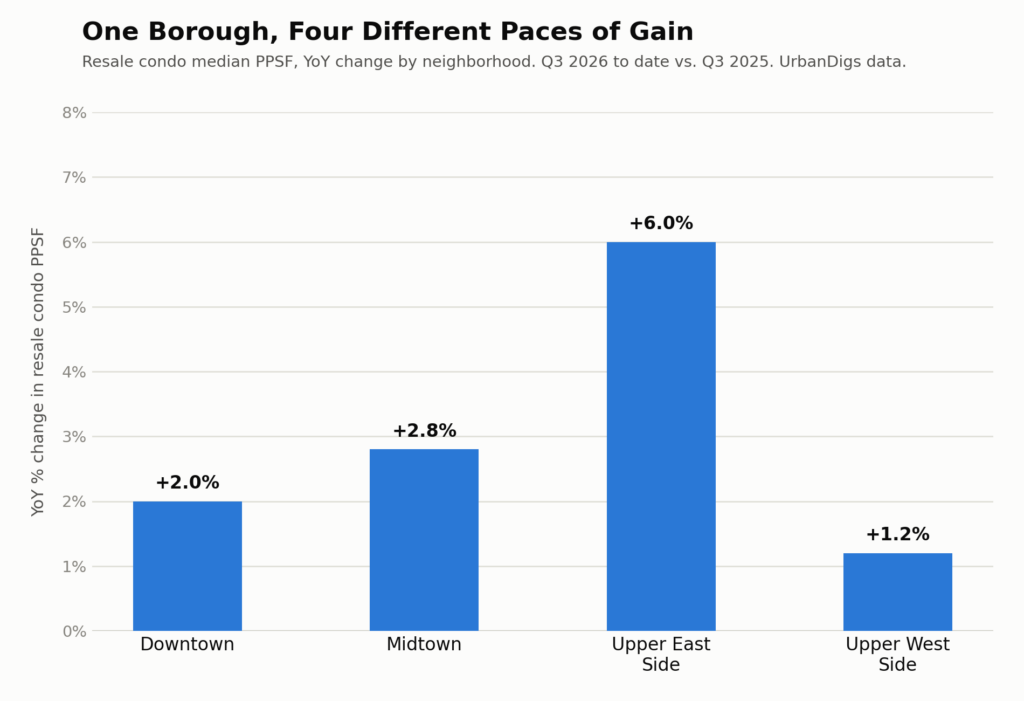
So far in Q3, resale condo PPSF is running approximately:
- +2.0% year over year Downtown
- +2.8% in Midtown
- +6.0% on the Upper East Side
- +1.2% on the Upper West Side
One borough.
One record headline.
Four very different pricing trajectories.
That is why broad market statistics are useful context, but dangerous pricing tools.
Scarcity doesn’t rescue bad pricing.
For sellers, this is a better environment than transaction counts alone would suggest.
Inventory is tighter. Negotiating discounts have compressed. Good apartments have more pricing support.
But scarcity is not a blank check.
If buyers do not see value at the asking price, aspirational pricing can still cause a listing to stagnate.
Buyers do not stop looking at relevant comps simply because Manhattan PPSF printed a record.
For buyers, the opposite mistake is assuming that lower transaction volume must eventually mean lower prices.
Maybe it will.
A recession, employment shock, forced selling, or meaningful increase in inventory could change the setup quickly.
But waiting for lower transaction volume to automatically produce lower prices has not worked particularly well so far.
The bigger risk may be that buyer urgency returns before meaningful new supply does, creating something closer to a short squeeze for desirable property.
For agents, the headline is context. The property is the pricing decision.
The record Manhattan PPSF absolutely belongs in client conversations.
It tells sellers that limited inventory is creating stronger pricing support than transaction volume alone might suggest.
It tells buyers that waiting for low volume to automatically translate into lower prices may be a poor strategy.
But neither side should use $1,500 per square foot as the number that determines what an individual apartment is worth.
That requires working down from:
Manhattan → neighborhood → building → line → apartment → relevant comparable sales → current competitive environment
That final layer is where pricing decisions actually happen.
Where UrbanDigs Pricing Reports fit
UrbanDigs is built to move from broad market context to property-specific pricing intelligence.
A Seller Pricing Report or Buyer Pricing Report evaluates the actual property in front of you using relevant comps, building and neighborhood context, competitive conditions, buyer behavior, and the market evidence needed to understand where that property is likely to trade.
Because a record Manhattan market number can tell you the direction of the wind.
It cannot tell you how to price a specific apartment.
Have a property where the headline market numbers aren’t enough?
Request a Property-Specific Pricing Report
Price is reality. Everything else has to prove it.
Data Notes
- Manhattan resale condo PPSF data through August 2026
- Q3 2026 figures are quarter-to-date
- Supply reflects publicly visible Manhattan active inventory
- Neighborhood comparison reflects resale condo median PPSF, Q3 2026 to date versus Q3 2025
- Source: UrbanDigs
John Walkup is Co-Founder of UrbanDigs, New York’s independent real estate pricing intelligence company, and a Forbes contributor covering NYC housing trends and pricing strategy.