
The post-Labor Day market does not simply bring more listings. It changes the competitive position of nearly every property entering, relaunching, or sitting on the market.
Labor Day is New York City real estate’s unofficial restart button. This year it falls on Monday, September 7. Agents return, sellers relaunch, delayed inventory arrives, and buyers suddenly have more choices. The mistake is treating that annual reset as background noise. It is a pricing event.
Experienced agents already know that the fall market gets busier. The harder question is what the shift means for one specific apartment, in one building, competing inside one price band. That is the difference between market commentary and pricing intelligence.
Borough-wide statistics can tell you the tide is moving. They cannot tell you whether your property will rise with it or get buried beneath the new competition. That answer lives at the hyper-local level, where active inventory, building history, buyer alternatives, listing climate, and price positioning collide.
The September wave is not opportunity. It is competition.
Last fall, Manhattan new listings jumped from 608 in August to 2,100 in September, a 245% increase in one month. Brooklyn followed the same seasonal pattern, rising from 599 new listings to 1,065, a 78% increase.
The same Manhattan reset appeared in the two prior years. New listings increased from 767 in August 2023 to 1,946 in September, then from 685 in August 2024 to 1,891 in September. This is not a surprise event. It is a recurring competitive shock.
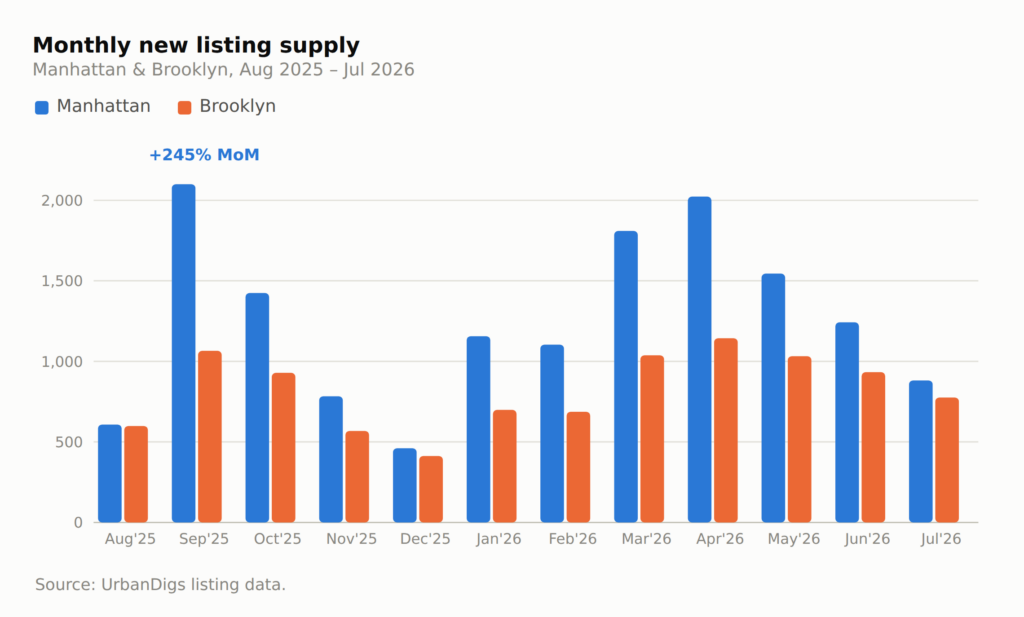
Source: UrbanDigs listing data. The chart shows the August-to-September 2025 supply reset used to inform the fall 2026 strategy.
A seller listing immediately after Labor Day is not merely entering a more active market. The property is entering the most crowded launch window of the year. Every new listing competes for the same buyer attention, the same saved-search alerts, and the same limited first-impression window.
That means the relevant question is not, “Is September a good time to list?” It is, “Where will this property sit when the September competition arrives?”
For sellers launching this fall
The wrong strategy is to price from old closed sales, add a cushion, and assume fall demand will absorb the difference. Buyers do not shop against last year’s comps. They shop against the alternatives available today.
Before launch, sellers and agents should answer four questions:
- What will the buyer see beside this property? Active competition defines relative value more immediately than a distant closed sale.
- How crowded is the exact segment? A borough-wide supply increase matters less than the new inventory entering the same neighborhood, property type, bedroom count, and price band.
- Is demand likely to arrive at the same time? Last fall, Manhattan contract activity did not fully respond to the September listing wave until October, when contracts increased from 736 to 1,011.
- What is the price-adjustment plan? If the market rejects the initial position, the seller needs a decision point before the fall window begins closing.
This is where most pricing decisions break down. Agents may understand the broader fall pattern and still misprice the individual property because the analysis stops at the borough, neighborhood, or comp level.
Independent Pricing Intelligence adds the missing context. It asks not only what similar properties sold for, but how this property is positioned against the competition buyers can choose from now.
If the listing has been sitting since summer, Labor Day is a decision point
A stale summer listing does not receive a clean reset simply because the calendar changes. It enters September carrying days on market, an existing pricing history, and a buyer pool that has already seen it.
UrbanDigs data shows Manhattan’s median listing discount widening as fall progresses, from roughly 3.7% to 3.9% during the summer to 4.2% in September, 4.4% in October, and 4.5% by November. Time on market compounds the problem. Listings under 30 days carry essentially no discount, while listings on the market longer than 120 days reach roughly 9%.
The practical implication: A meaningful price amendment around Labor Day can reposition a stale listing before the new fall inventory captures buyer attention. Waiting until October means competing against fresh listings and other repriced inventory after the market has already documented the listing’s weakness.
The goal is not to cut the price because fall is coming. The goal is to determine whether the current position will survive the fall competition. A reduction that does not move the property into a new buyer pool is not a strategy. It is a public admission that another reduction may be coming.
For buyers: more choice does not automatically mean lower prices
The September supply wave creates a real but narrow buyer advantage. New inventory arrives before contract activity fully catches up, giving active buyers more alternatives and temporarily reducing the competition around any one listing.
But that does not make fall 2026 a discount market. The supplied UrbanDigs data shows Manhattan’s July 2026 median sale price at $1.305 million, up 5.5% from July 2025. Brooklyn reached $1.166 million, up 13.5% year over year.
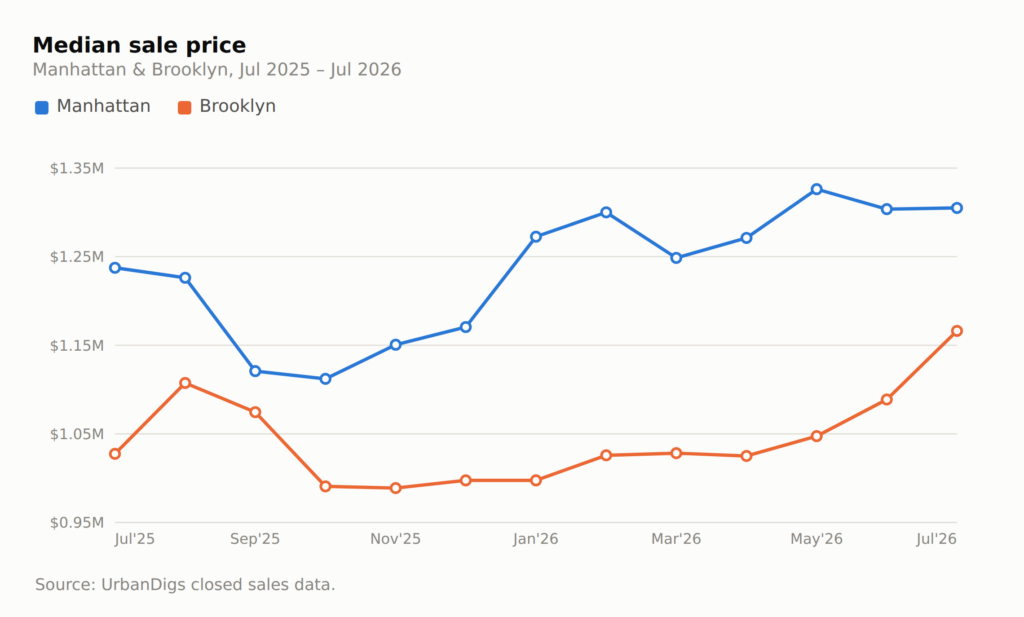
Source: UrbanDigs closed-sales data. Median sale prices shown from July 2025 through July 2026.
Buyers should reset expectations around availability and pace, not assume prices are collapsing. The opportunity is to compare more properties, identify relative value faster, and act before fall demand catches up.
Old comps can mislead buyers here too. A June analysis may not reflect the September competitive set, a new listing wave, or a building where one fresh contract changes the pricing conversation. The buyer who relies only on trailing sales may miss the property that is correctly positioned today.
What agents should change now
Agents should stop treating the fall market as a date on the calendar and start treating it as a change in the pricing environment.
- Before a listing presentation: Map the active and likely incoming competition, not just the closed comps.
- Before launch: Establish a pricing range, a competitive position, and a scheduled review point if the expected response does not appear.
- For a stale listing: Decide whether the current price meaningfully reaches a new buyer pool before the September wave peaks.
- For buyers: Re-run the analysis when the available inventory changes. More choice can change relative value even when the broader price trend remains firm.
The broad market can point you in the right direction. It cannot price a specific property. That is the layer agents miss, and it is exactly what a Seller Pricing Report is designed to resolve.
The market resets. Your pricing cannot stay static.
September does not make a property more valuable or less valuable by itself. It changes the field around it.
More listings change the buyer’s alternatives. Delayed demand changes the pace. Building activity changes the comp story. Time on market changes the negotiation. A defensible price has to account for all of them together.
That is why pricing is not just a comp exercise. It is a positioning decision.
Get Independent Pricing Intelligence for Your Fall Listing
The UrbanDigs Seller Pricing Report combines active competition, recent sales, building activity, listing climate, and hyper-local pricing behavior to show where a property is positioned before the fall market delivers its verdict.
👉 Get Your Seller Pricing Report
Frequently Asked Questions
Is September a good time to list a home in NYC?
September brings a large increase in new inventory and renewed buyer activity. It can be an effective launch window, but sellers also face the highest concentration of new competition. Success depends on pricing the property against its exact competitive set, not relying on borough-wide seasonality alone.
Should a stale summer listing cut its price before Labor Day?
Not automatically. The correct decision depends on buyer feedback, days on market, competing inventory, and whether the new price would move the property into a different buyer pool. A small reduction that does not change the property’s competitive position is unlikely to solve the problem.
Does more fall inventory mean NYC prices will fall?
No. More inventory gives buyers additional choices, but the supplied UrbanDigs data shows year-over-year median sale-price gains in both Manhattan and Brooklyn through July 2026. Supply, demand, and pricing need to be evaluated together.
How is a Seller Pricing Report different from a CMA?
A traditional CMA centers on comparable properties. A Seller Pricing Report adds active competition, building activity, listing climate, recent pricing behavior, and hyper-local positioning to help determine how a property fits into the market buyers are seeing now.